Art is Basic has moved!

Art is Basic has moved!
Visit my new blog location by clicking on the Art is Basic logo.
Showing posts with label watercolor. Show all posts

Saturday, January 19, 2013

How to Paint Gorgeous Clouds with Watercolor-- 5th and 6th Grade

Clouds. Aren't they amazing? 

Cloud photography by Carolyn Cochrane  (visit her Etsy shop by clicking on the link)


Two years ago I took a very helpful watercolor painting class.  One of our assignments was to paint clouds. 

Painting by Marcia Beckett

Connecting Art with Science

I love to make connections with other subjects.  This one is perfect for my 5th/6th grade because in Science class they study cloud identification.  They come into my class with a broad understanding of clouds which makes my lesson richer.  

Clouds and Art Resource

The Clouds in Art Gallery is amazing.  This gallery features famous paintings (for example, by Van Gogh, Constable, Turner, Renoir) with the clouds identified.  To start this lesson, I downloaded the powerpoint from the website to show my students.

The One Tool I Can't Live Without for Watercolor Painting

Hands down, my favorite tool for watercolor painting is the fan brush.   Buy fan brushes in a variety of sizes.  If your budget is small, start by buying a small assortment every year.  They are indispensable for creating texture! 
Blick Scholastic Wonder White Fan Blick Scholastic Wonder White Fan
Blick's White Taklon delivers the texture and responsiveness of Red Sable, yet holds up to the caustic nature of solvents and acrylic paints with greater durability, making these brushes a must-have for the classroom. The selection of shapes and sizes available means there's a Wonder White brush for every media and application. The sharp point has good spring. Long handles are finished in blue gloss with nickel-plated brass ferrules.


Tips for Using the Fan Brushes

1.  Find reference photos of clouds to use while painting.

2.  Use the paper towel to dab your brush so it is not dripping wet.  A dry brush will create a nice texture.

3.  Use a light feathery technique to make the texture in the clouds or grass.  Look at this video to see what I mean.  For the clouds, hold the brush flat and dab it up and down.  

4.  When painting the sky, remember to leave the cloud areas white, unpainted.  Paint the sky around the clouds.  While the blue paint is still wet, add other colors (different shades of blues, purples, etc) on top and it will blend the colors together.  Creating variations in the shades makes a more realistic effect.  

5.   Go back in to add depth to your clouds with light touches of grays, pinks, purples.. the sky's the limit! 


Additional Tips for Watercolor Painting Landscapes

  • If you can afford it, don't skimp on the quality of the watercolors for kids.  It does make a big difference, in my opinion.  Every two kids can share the paints.  So if your highest count of kids in a class is 26, buy 13 sets if you can.   Simply instruct them to place the watercolors in between them.  I also find that this helps them to monitor the muddying of the colors.. no one wants all their paints to turn black from careless mixing.   
  • Use a sea sponge for rocky or sandy texture.  
  • As for paper, I have experimented with a lot of paper and I am still on the never-ending quest to find the perfect, non-wrinkly, affordable watercolor paper for kids.  PLEASE let me know if you have any recommendations.  What I have used recently for painting with watercolors and tempera is White Tag Board from Nasco.  I find that it takes paint well and looks pretty nice.  I have not been afraid to get out the iron and carefully iron paintings that have buckled.  Another option is to take a stack of heavy books and place them on top of the dried paintings.  What do you do?


Friday, November 30, 2012

Frogs in a Pond (with Monet) 1st Grade

I love lessons where I can tie in different areas of study, art history and art techniques!  This is a project I developed that incorporates study of frogs, Monet and watercolor painting.


To start this project, we learn about the artist Claude Monet and his paintings of ponds and lilypads.  We read a book about Monet:
(This series is awesome for read-alouds in class.  I love the picture books about art, but I want the pictures in the book to be actual pictures made by that artist.  I don't like picture books that have art created by a different illustrator.  For example, if the book is about Van Gogh and none of the pictures in the book were painted by Van Gogh, the story book can be confusing to kids.  Does that make sense?  There are a lot of picture books out there about artists, but the artwork was done by someone else.  This series of books combines cartoons and ACTUAL artworks by the artist, which I feel is so important.  And this series breaks things down in easy-to-understand concepts for the kids.  I always tell the kids ahead of time that the cartoons about the artist were not drawn by the artist, but by someone else.. otherwise one of the kids will raise their hands and ask, "So did Monet draw these cartoons?")  Anyways......  After we read this book, we also watched the movie "Linnea in Monet's Garden".  As we watch the movie, I again make sure to point out the actual pictures Monet painted. 


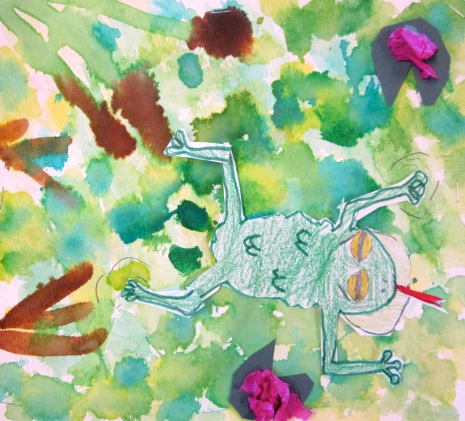
After we learn a little about the background of Monet's artwork, we paint a watercolor picture of a pond.  I show them how to use the wet-on-wet watercolor technique.  Paint the paper with water first, then add wet colors of paint.  We talk about cool colors and the colors they might see in a pond.

Then, we cut out lilypads from green construction paper and added little fluffs of tissue paper for flowers.

The first graders read a series of books called Frog and Toad in their language arts classroom.  At the same time they study frogs (and other amphibians) in Science class.  In art class, we look at pictures of frogs and observe the details and draw them as realistically as possible. They do some practice sketches first and then I teach them on the whiteboard some steps to draw a frog if they are struggling.  They outline these frogs with green marker and color in with crayons.  Then, they are cut out and glued to the pond.  Some of them glue down the legs and bend them so the frogs pop off the page, and some of the kids glue them down flat. 


Thursday, October 18, 2012

Painted Leaves-- First Grade


 These lovely fall leaves were painted with watercolor by the 1st graders!


Tuesday, February 28, 2012

Castles with Pen and Watercolor-- 5th/6th grade

 
5th/6th grade Castle Drawings

The 5th and 6th graders have been studying the Medieval time period in their Social Studies class.  For this project, the 5th and 6th graders looked at pictures of castles and drew their own castle using pencil and pens.  Then, they added watercolor washes to the picture. 


Some of the students discovered that it looks really nice when the castle is left white.


Wednesday, February 8, 2012

American Landscape Paintings--3rd/4th Grade


 American Landscapes  The 3/4s learned about Colonial times and Westward Expansion.  The students watched a video about American landscape artists during the 19th century and they painted their own landscapes.  One of the goals was to use inspiration from the environment to create a painting.  The students chose a landscape scene from pictures of America.  Painting lessons include how to add texture with a fan brush, how to mix colors and how to add shadows on a mountain.

I showed them my painting of a rolling hills landscape and demonstrated how I created those textures through sponges, fan brushes and using the edges of a flat brush.  


Friday, January 6, 2012

Wednesday, November 16, 2011

Frogs on a Lilypad with Monet-- 1st grade


       In Art class, the 1st graders looked at Claude Monet’s artwork, especially his paintings of ponds.  Using a variety of painting techniques the 1st graders painted a pond with watercolors.  Frogs were drawn with crayons and markers. Lilypads were added with construction paper and tissue paper.  The children were studying frogs and toads in their Science class and read about them in LA/SS/D.


Wednesday, August 17, 2011

Paintings from my watercolor class

I've been taking a watercolor class this summer, which has been very useful in learning new techniques and basically how to approach painting.  Here are a few paintings that I made this summer:


I think it will be useful especially when I teach the lesson about American Landscapes.

Wednesday, July 13, 2011

Clouds Watercolor Painting

I am taking a watercolor class this summer at the local recreation and parks department.  Our first real painting assignment was to paint a picture of clouds.  No, it couldn't be just a white cloud on white paper.  This was a great assignment, because it is actually one that I do with my 5th and 6th grade students.  Now I will know some new tips and techniques to share with them. 

I'm pleased with how the clouds turned out, but I might go back in and define the tree/grass area.

Tuesday, April 19, 2011

Third/Fourth grade Landscapes

 American Landscapes  The 3/4s learned about Colonial times and Westward Expansion.  The students watched a video about American landscape artists during the 19th century and they painted their own landscapes.  One of the goals was to use inspiration from the environment to create a painting.  The students chose a landscape scene from Wisconsin or a state they have visited.   Painting lessons include how to add texture with a fan brush, how to mix colors and how to add shadows on a mountain.

LinkWithin

Related Posts with Thumbnails