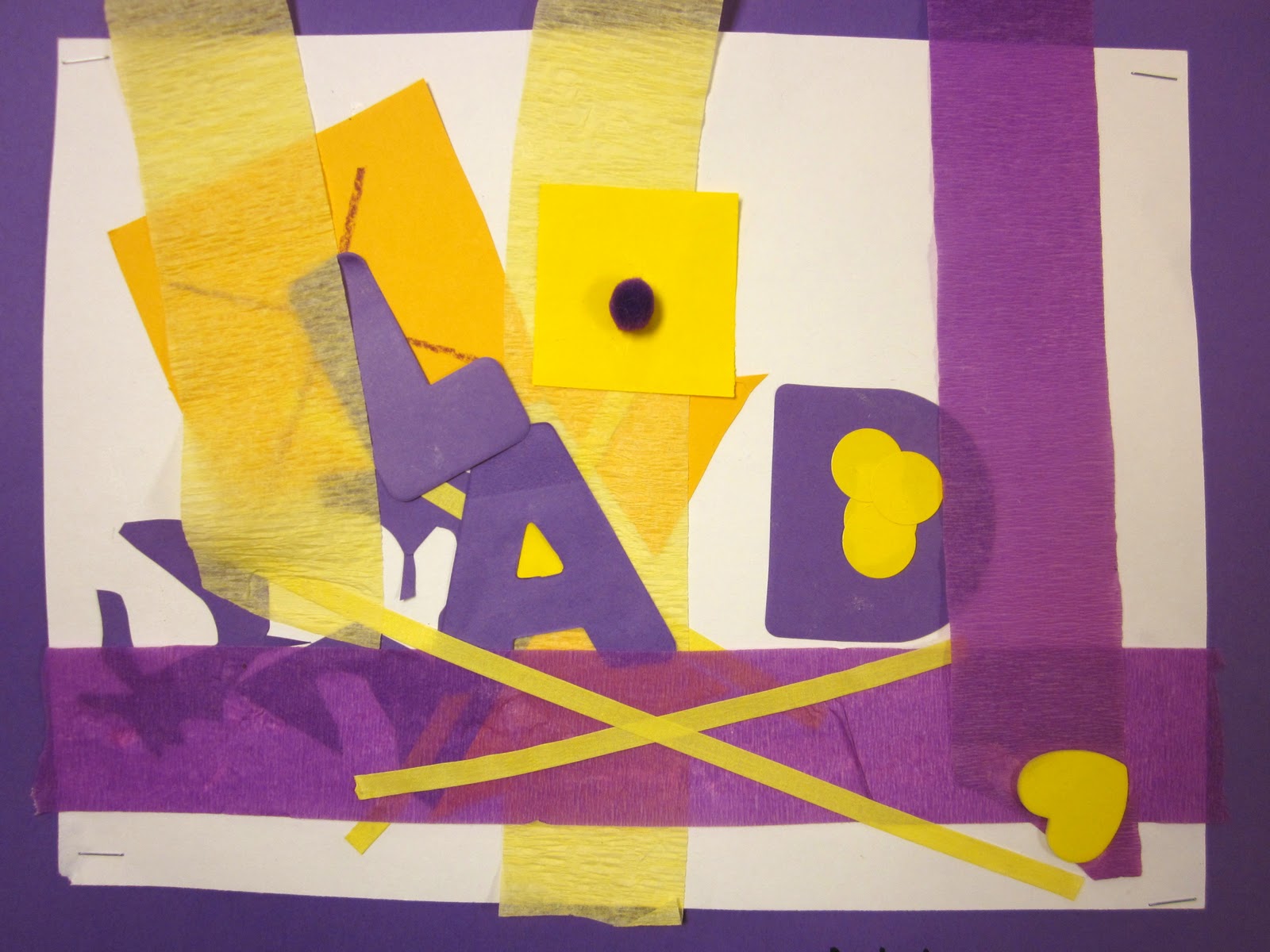
Complementary Color Collages
by the 1st Grade
 This project introduces the first graders to complementary colors. I show them the color wheel and I explain how the complementary colors are across from each other on the color wheel. They are the "opposites". If you mix the two of them together you would get a brownish or grayish color. We talk about the primary/secondary colors and focus on the pairs of red + green, blue + orange, and violet + yellow. At this point, a kid usually will point out the intermediate colors and I show them how those also have complementary colors. For this project, we focus on the complementary pairs I have listed above. I also read them this cute book called "The Orange Book" by Richard McGuire. It is out of print, but I picked one up on amazon.com last summer. The story is about oranges, but the pictures are all printed in orange and blue (which is one of the complementary pairs we will be using.) I often like to read a story book that is inspiring to the subject matter we are studying.
 |
| A bag with orange and blue materials. |

Preparation: Gather colorful materials and place them in ziploc bags according to complementary pairs. I include: paper scraps, colorful tape, foam letters and pieces, stickers, colored cellophane, pompons, crepe paper, paint chip samples and stamps. I have these fun marker stampers: Crayola 10 Count Expressions Washable Mini-Stampers
 which I put out for the children to use. This is a great time to use up those bits and bobs and random scraps.
After the introduction, I place the bags of complementary color "stuff" at different tables. Then I say, "All the students who want to use orange and blue in their collage, sit at this table." and so forth. Usually the class is pretty evenly distributed. Then, they use the materials however they would like to make a complementary color collage.
I like this project because it allows the kids to explore the materials in their own self-directed way. Each of them comes up with such unique ways to put the materials together.
At the end of the class, whatever is left over gets put back in the bags and I save them for next year (and replenish them as needed.)
 |
| in progress collage. |
 |
| Kids open up the bags, share what's inside and talk about the materials with their neighbors. |

 |
| This imaginative boy turned his collage into a sculpture! |
 |
| This boy enjoyed drawing lots of fun pictures with his markers. |


-->
How do you teach about complementary colors to
the youngest students?